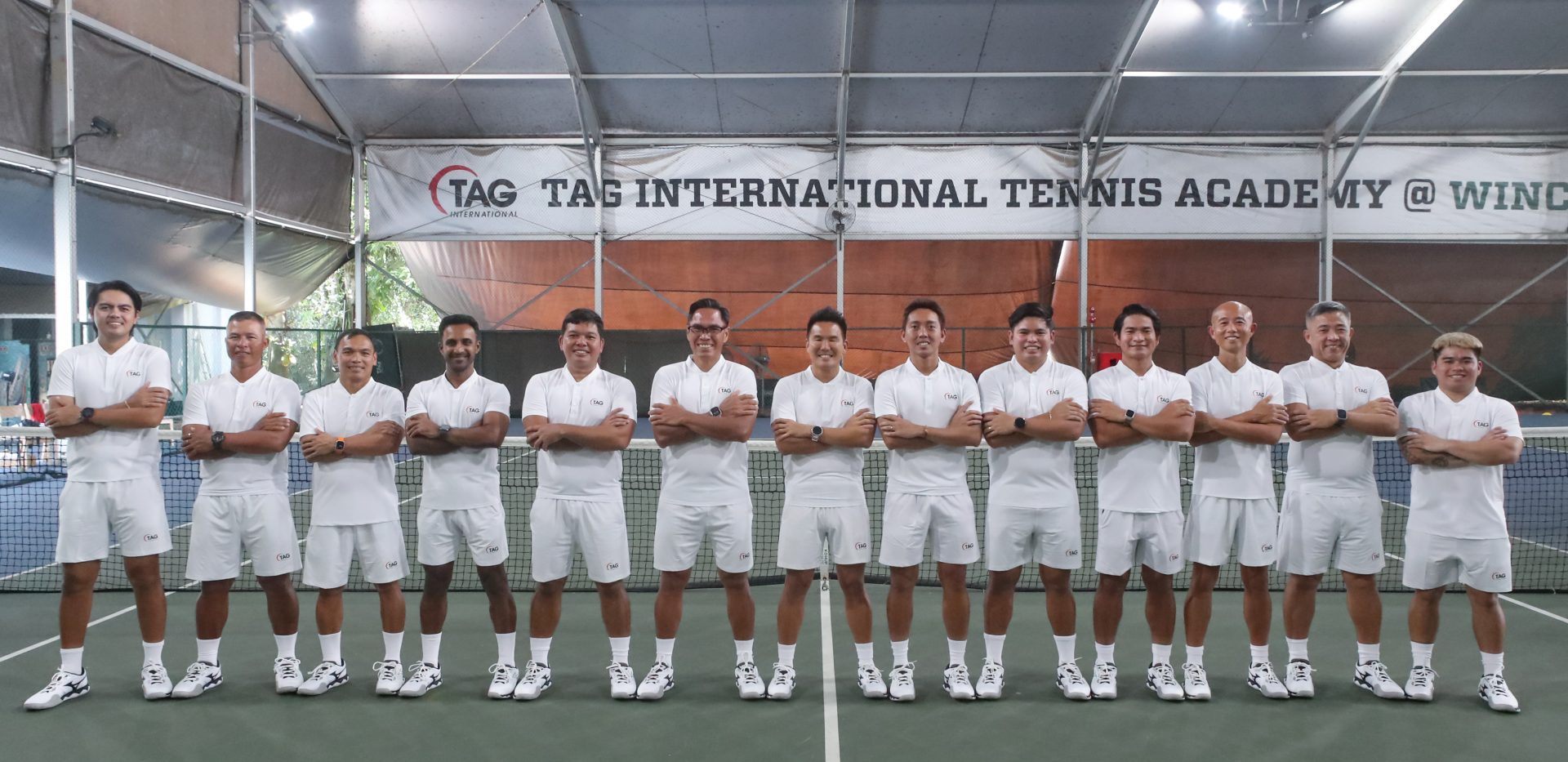

The chip-and-charge is one of the most psychologically devastating tactics in tennis. In this guide, TAG International Tennis Academy Singapore coach Ray Evan Paler breaks down exactly how to master this aggressive return strategy — from the skills you need, to where to aim, to how to finish the point at the net.
What is the Chip-and-Charge
Specifically, the chip-and-charge refers to the tactic where the returner hitting a block bunt with underspin or a knifing slice when receiving serve and following it in with speed to dominate the net.

What are the advantages of the chip-and-charge
The advantages of the chip-and-charge are several, as detailed below:

- It forces the server to think about their serve, knowing that his opponent is coming to the net on the return. This results in a lot of missed weak serves or even double faults.
- Additionally, it elicits a lot of cheap points from the pressure of an approaching opponent off missed third shots.
- Only the very best third shots will trouble the chip-and-charger and many other third shots that are less than good will be punished with a first volley putaway, deep set to the open court, or back behind to set up the finishing volley.
- Furthermore, this tactic puts continuous and relentless pressure on the server, time and time again, leading to mental fatigue, frustration, and loss of concentration.
- Moreover, it constantly makes the opponent feel very rushed by taking time away from them
- This approach also keeps jerking the less mobile players around as you vary the approach to the open court or behind them or short, and volleying into the open court or behind them.
- Over the course of a match, a player constantly faced with this might trigger muscular injuries or cramps if they are not well conditioned.
Why Chip the Return instead and not Strike the Return as usual

Naturally, many players will ask why to chip the ball and not hit the cover off the ball?
- It gives you more margin for error by simply redirecting the shot to your target with good amount of underspin.
- It gives you more time to close into the net for a better volleying position.
- The chip or slice return will cause the ball will stay low, forcing the opponent to hit up, which results in an easier volley most of the time.
What tennis skills are needed to use this chip-and-charge tactic

- You need to have a knifing backhand slice
- Have the ability to take the return early with good hand and racquet skills
- Have a short compact swing
- Have the ability to time the ball well
- Have the ability to take the ball on the rise
- Have dynamic balance to split, load, transfer and press on the return of serve when the serve can be quite fast or with wicked spin
Which targets to return slice or chip to?

- As there are advantages both down the line or cross court, the primary target most of the time should be to the oppoent’s obvious weakness. You can vary it deep or angled short (if crosscourt) or narrow middle by on the weaker wing.
- Can also choose to target the better shot, if on that wing, your opponent has a significantly longer backswing.
- Keep changing targets to keep your opponent off balanced.
- Deuce court forehand return – down the line and follow it in.
- Deuce court backhand return – into the ad court and follow it in.
- Ad court backhand return – down the line and follow it in.
- Ad court forehand return, down inside out to narrow or wide backhand and follow it in.
How to cover the court following the chip

- To start with, whichever way you return, follow the line of the ball to the net towards the net to bisect the geometrical return possibilities while giving up the extreme.
- After a while, a player will have preferred tendencies, you can start leaning towards those targets.
- You may also notice that your opponent may not have the ability to change the direction of the ball effectively off your chip-and-charge e.g. to go up the line off a low crosscourt slice return, and you can be tight on his preferred, or limited response.
Really useful tips on applying the Chip-and-Charge Tactic
- Do not be afraid to hit a short chip when coming in. It is difficult for many two-handed backhand players to move forward and get under a short, low chip with the added pressure of having to hit a passing shot.
- Next, stand close or even inside the baseline on the return and take the ball early. Let your opponent sense you will be attacking them.
- Additionally, keep the backswing very compact than on a normal slice
- Moreover, be quick and get as close to the net much as possible before split stepping just before your opponent hits the ball so that you will hand and move in either direction as he hits makes contact with the ball.
- Furthermore, apply as heavy backspin as you can to skid the ball and keep it low so your opponent has to hit up.
More Tips on Applying the Chip-and-Charge
- In addition, keep the approach very deep. This is key. An approach that is too short opens up a lot of passing angles.
- In addition, have a forgetful mindset. It will not work everytime and you will get passed sometimes. What is important is to win more than you lse, and on pivotal points like 30-30.
- Do it in a pressure situations for the server when the opponent is down and really needs the point. It is more difficult for then in such instances.
- As a result, do not try to win the point with the first volley if you are not on top of the net. If the opponent’s shot comes back low and you are not inside of the service line, get your first volley deep and continue to close and look to put away the next ball instead.
- Also, try it on a first serve once in a while. When the opponent knows you can do it on the first serve, it exponentially increases the pressure on them on the second serve.
The TAG International Tennis Academy Definitive Guide Series
We hope you have found this article informative. If so, please share it with your tennis playing family and friends.
Additionally, this article is part of the TAG Definitive Guide Series which encompasses the best tennis advice available on the internet. If you enjoyed this article, some other interesting tennis instruction articles you may like:
Technical Instruction Guide
- Best tips to a Powerful Modern Forehand by Coaches of TAG International
- Best tips to a reliable Double Backhand by TAG Coach Israel Abarquez
- Best tips to a powerful serve by TAG Coach Michael Mantua
- Best tips to a on the return of serve for a one-hander by TAG Coach Peter Egos
- Best tips to a devastating one handed backhand by TAG Coach Bo Alburo
- Best tips to a knee buckling drop shot by TAG Coach Ten Rapeepat
- Best tips to a ferocious inside out forehand by TAG Coach Jeremy Maniago
- Best tips to a picture perfect topspin lob by TAG Coach Parek Pratim
- Best tips to a ground hugging backhand slice by TAG Coach Dave Regencia
- Best tips to a scissors-kick overhead smash by TAG Coach Michael Mantua
- Imparting the Advanced Foundation to Juniors to Ensure their Long Term Development
Tactical Instruction Guide
- Best tips to an impregnable defence by TAG Coach Rocky Paglalunan
- Best tips on the art of poaching in doubles by TAG Coach Dave Regencia
- Best tips to an effective Serve and Volley Game by TAG Coach Ray Evan
- Best left-hander tips by TAG Coach Parekh Pratim
- Best tips to hit the ball Early on the Rise by TAG Coach Rapeepat Thonghatta
- Why an All Court Player is a truly formidable style of play by TAG Coach Bo Alburo
- The Way of the Counterpucher – what makes Daniil Medvedev and Coach Peter Egos So Good
Tournament Preparation Guide
Fitness, Mental & Tennis Lifestyle Guides
- Best tennis conditioning exercises to become more accurate and powerful and outlast your opponents by TAG Coach Bobby Esquivel
- Best advice on Nutrition and Diet in Tennis for Peak Athletic Performance by TAG Coach xt
- Mental Toughness Secrets in Tennis to Win You More Matches by TAG Coach xt
- Essential Items you need in your Tennis Bag on Match Day by TAG Coach xt
Singapore Tennis Information Guide
- Complete guide to Ladies Tennis in Singapore
- Comprehensive guide to tennis strings, and the best tennis stringers in Singapore
- Spotlight: ATP Malaysia Open Sharon Yeo of String Fix in the Central Business District of Singapore
- Spotlight: Australian Open Stringer Melvin Tan of Leisure Sports in Orchard Singapore
- Spotlight: Best children tennis birthday party host Mervyn Goh of ImaginArts
- Spotlight: Interesting things to know about Coach Rapeepat Thonghatta including that he was coach to 2 ATP Players before joining TAG
- 新加顶级的网球学校-TAG国际网球学校
- Why TAG International Tennis Academy is widely acknowleged to be the best tennis academy in Singapore
- Racquet Review: The Wilson Pro Staff Roger Federer Laver Cup Limited Edition RF97 2019
- Spotlight: Coach Bo Alburo – ITF Men’s 35+ World #2
- Spotlight: Coach X – ITF Men’s 35+ World #56
- Coach X appointed as Senior Coach of the ActiveSG Tennis Academy
- Coach xt and Peter Egos win Singapore Open Men’s 2019 Doubles Title
Contact Us
If you are looking to improve your tennis, you can look to some of Singapore’s best private tennis coaches such as the tennis coaches from the best tennis academy in Singapore, TAG International Tennis Academy by taking private tennis lessons. We can be contacted at +6598395232, or contact us HERE.
TAG International Tennis Academy
Where Champions Learn to Play
Winchester Tennis Arena
Where it’s Game On, Always.
