

Packing your tennis bag for your tennis match day is very important. While you may pack a lot of other items, make sure you include these 14 items to feel really prepared for all kinds of surprises that may occur during your tennis match.
Last updated: October 2026. Reviewed by Coach XT (Tan Xu Teng), founder of TAG International Tennis Academy — PTR Full Professional, AATC Level 2 and NROC-accredited, career-high ITF Men’s 35+ world No. 56 and Singapore Open Champion 2019.
Why a Singapore match bag is not the same as a European one
Singapore’s courts are warm and humid the whole year round, and most club and condominium courts here are outdoor and unsheltered. In practice that changes what belongs in your bag more than skill level does. Grips go slick inside a set. Cotton stays wet once it is wet. Shoes do not fully dry between matches. Cramp stops being a rare accident and becomes something you plan around. Almost every item on this list earns its place for that one reason, which is why our coaches pack differently here than they would for an indoor winter season abroad.
If you are new to playing in this climate, read it alongside our coach’s guide to training safely in Singapore’s heat and humidity.
Racquets, strings and grips
Carry at least one spare racquet. A string can go at any point, and a mid-match restring is not an option — if your only frame breaks, the match is over. Ideally the spare is strung the same way as your main frame, so switching does not change how the ball comes off.
Overgrips are the single most-used item in a Singapore bag. On a hot or wet day a grip twisting in your hand will cost you shots long before your legs do, so pack two or three and change them without hesitating. Wristbands do the same job upstream, keeping sweat off your racquet hand so the grip lasts longer in the first place.
If you are not sure what you are holding or what is in your frame, our two reference guides cover both: the tennis grip guide to Eastern, Semi-Western and Continental and our comprehensive guide to tennis strings and stringing. For match-standard work locally, see our profile of ATP racquet stringing in Singapore with Melvin Tan of Leisure Sports.
Shoes, socks and a second set of clothes
Spare tennis shoes matter more here than most players expect. Older shoes fail in two ways in this climate: glue dries out and soles separate, or the shoe simply never dries between sessions. On an overcast day perspiration does not evaporate and the shoe stays soaked through the match. Carrying a second pair is cumbersome and still worth it on match day.
Pack spare socks for the same reason, and spare match clothing so you can change between sets — dry kit is a genuine performance item in humidity, not a comfort one. Then pack post-match clothing and slippers or casual footwear for afterwards. Do not stay in your tennis shoes once you are done: they are warm and wet inside, which is close to a perfect environment for fungal infection.
Hydration, salts and food
Bring a large water bottle — larger than you think you need, because court-side taps are not a given at every venue. Add isotonic salts to your drink for tough matches; replacing what you sweat out is what keeps cramp from developing in the first place, and it is far easier than treating it at 4-4 in the third.
For food, a dry energy bar or two bananas is enough. It is there for the long match, the dogfight you did not plan for, and the second match of a tournament day.
Skin, blisters and staying dry
Blister spray is essential in long matches and especially in tournaments. A blister is one of the few problems that genuinely ends matches that were otherwise winnable, and the treatment takes seconds if you have it with you. You will be glad you kept one in the bag someday.
A microfibre towel keeps you dry between points and stops your shorts getting wet enough to affect the balls in your pocket — a small thing that quietly affects your serve.
Balls
Carry tennis balls. It is the most obvious item and the most commonly forgotten one, on the assumption that someone else has brought them.
The complete 14-item checklist
- Tennis Balls – In case none of you have balls
- Blister Spray – This is essential in long matches especially in tournaments. It could be the difference between winning and giving up the match. You will be glad you kept one in your tennis bag someday.
- Dry energy bar or two bananas – In case you are in a dogfight.
- Isotonic Salts – Prevents cramps from developing. Just add to your drink for tough matches
- Tennis Over Grips – On hot days or raining days. You can’t play if your grip is wet and twisting in your hand on every shot you hit.
- Post tennis match clothing
- Tennis Racquets – Every tennis player should have at least one spare racquet in their tennis bag in case the strings snap
- Slipper or casual footwear – Do not wear your tennis shoes after match for they are warm and wet inside. Perfect environment for fungus.
- Spare Tennis Shoes – This is actually quite important if your shoes are a bit old. Glue dries up and the soles may come apart. Or on a day where the sun is not out and the perspiration from shoes cannot dry quick enough and the shoes become too wet. While it may be cumbersome, keeping a pair in your tennis bag on matchday is a very wise thing to do.
- Microfibre Towel – Keep dry during matches and prevents your shorts from becoming too wet to affect the tennis balls in your pocket
- Tennis Socks – Same as spare shoes.
- Spare match clothing – Change after every set to keep your athletic performance at a high level.
- Water Bottle – This one is obvious. Have a large one in your tennis bag.
- Tennis Wristbands – Prevents your grip from becoming too wet and having to change grips mid match to avoid grip twisting.
Frequently asked questions
What should a beginner carry in a tennis bag?
Start with the six that cover the most common problems: balls, a large water bottle, two overgrips, a microfibre towel, spare socks and a change of shirt. Add the spare racquet and isotonic salts once you start playing full matches rather than lessons. If you are at that stage, our complete guide to tennis lessons for beginners in Singapore covers what else to expect.
How many racquets should I bring to a match?
Two at minimum for any match that counts, strung the same way. A string can break on any ball, and borrowing a frame mid-match means playing the rest of it with equipment you do not know.
Do I really need spare shoes and socks in Singapore?
On match day, yes. Humidity means footwear often does not dry between sessions, and wet shoes cause both blisters and fungal problems. A spare pair also covers the older-shoe failure of a sole separating, which happens without warning.
What stops cramp during a long match in the heat?
Replacing salts as you go, rather than only water. Add isotonic salts to your bottle before you start a tough match instead of waiting for the first twinge. Our heat and humidity guide goes into scheduling and acclimatisation in more detail.
How often should I change my overgrip?
As soon as it starts to move in your hand. In Singapore conditions that can be once a set on a hot afternoon, which is why two or three spares belong in the bag rather than one.
About the coaches behind this guide
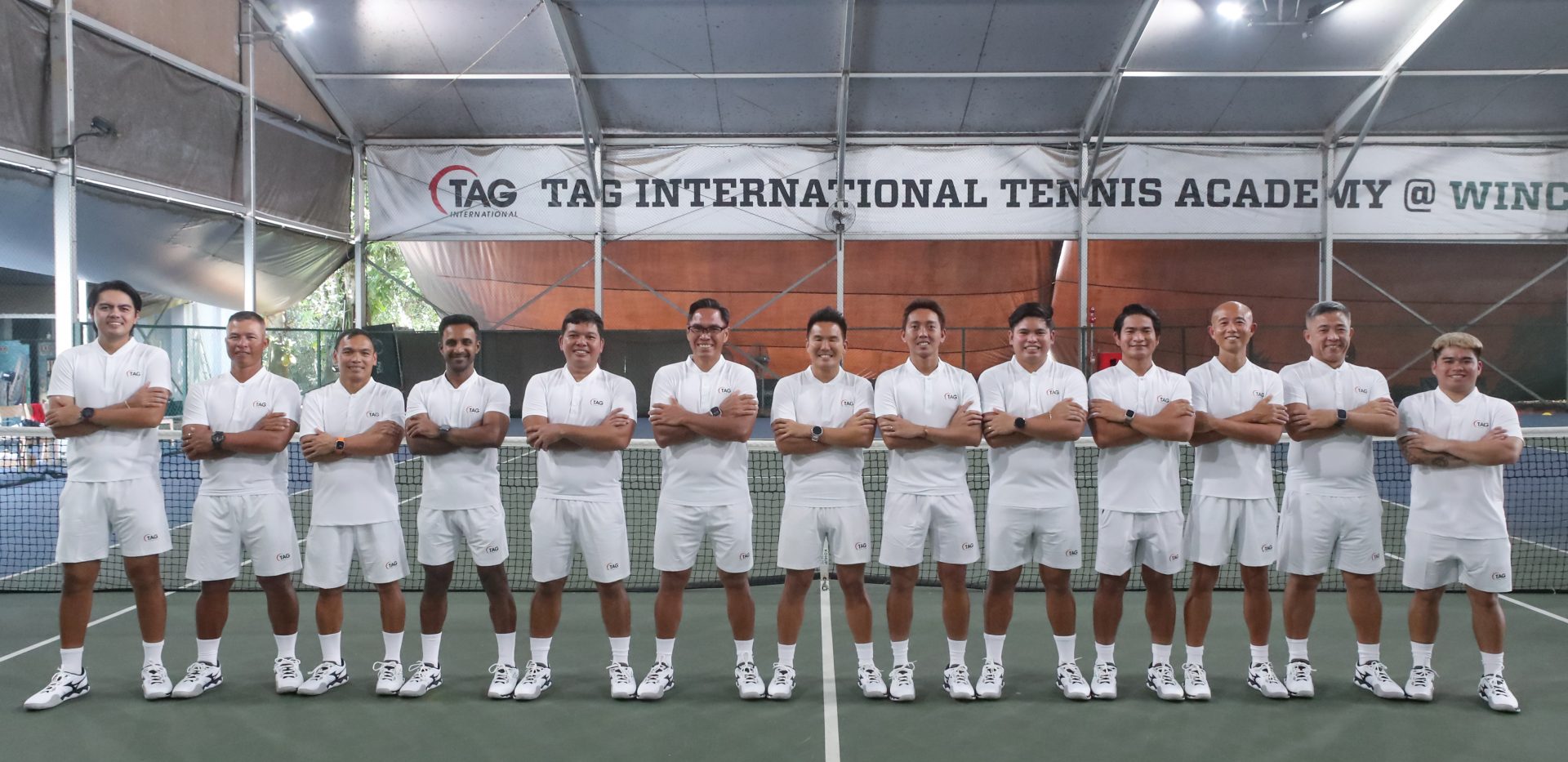
This checklist comes out of match-day and tournament coaching at TAG International Tennis Academy, founded in 2007, and at Winchester Tennis Arena at Alexandra Park, the four-court indoor venue built in 2013 that TAG calls home. Indoor courts remove the weather from the equation; everything above is written for the outdoor courts most players actually compete on.
Coaches in the TAG and Sanwa X network who compete or have competed at ranked level, with credentials as published on their own profiles: Coach XT (Tan Xu Teng), PTR Full Professional and career-high ITF Men’s 35+ world No. 56; Coach Bo Alburo, ITF Men’s 35+ World No. 2 in singles; Coach Kento Takeuchi, former ATP professional with a career-high ATP ranking of No. 378 and All Japan U-18 Champion; and Coach Wataru Ochi, with more than 25 years coaching in Singapore and experience working alongside WTA and ATP tour players.
For junior players building toward tournaments, see our junior programmes for ages 3 to 17. Lessons are also available at your own block through condominium tennis coaching. Group and private tennis at NTU@one-north is run by Sanwa X Tennis Academy, and if you are weighing the two racquet sports, our tennis versus pickleball comparison sits alongside the courts and coaching at PickleChoo.
TAG International Tennis Academy
Where Champions Learn to Play
Winchester Tennis Arena
It’s Game On, Always

2 comments
Comments are closed.