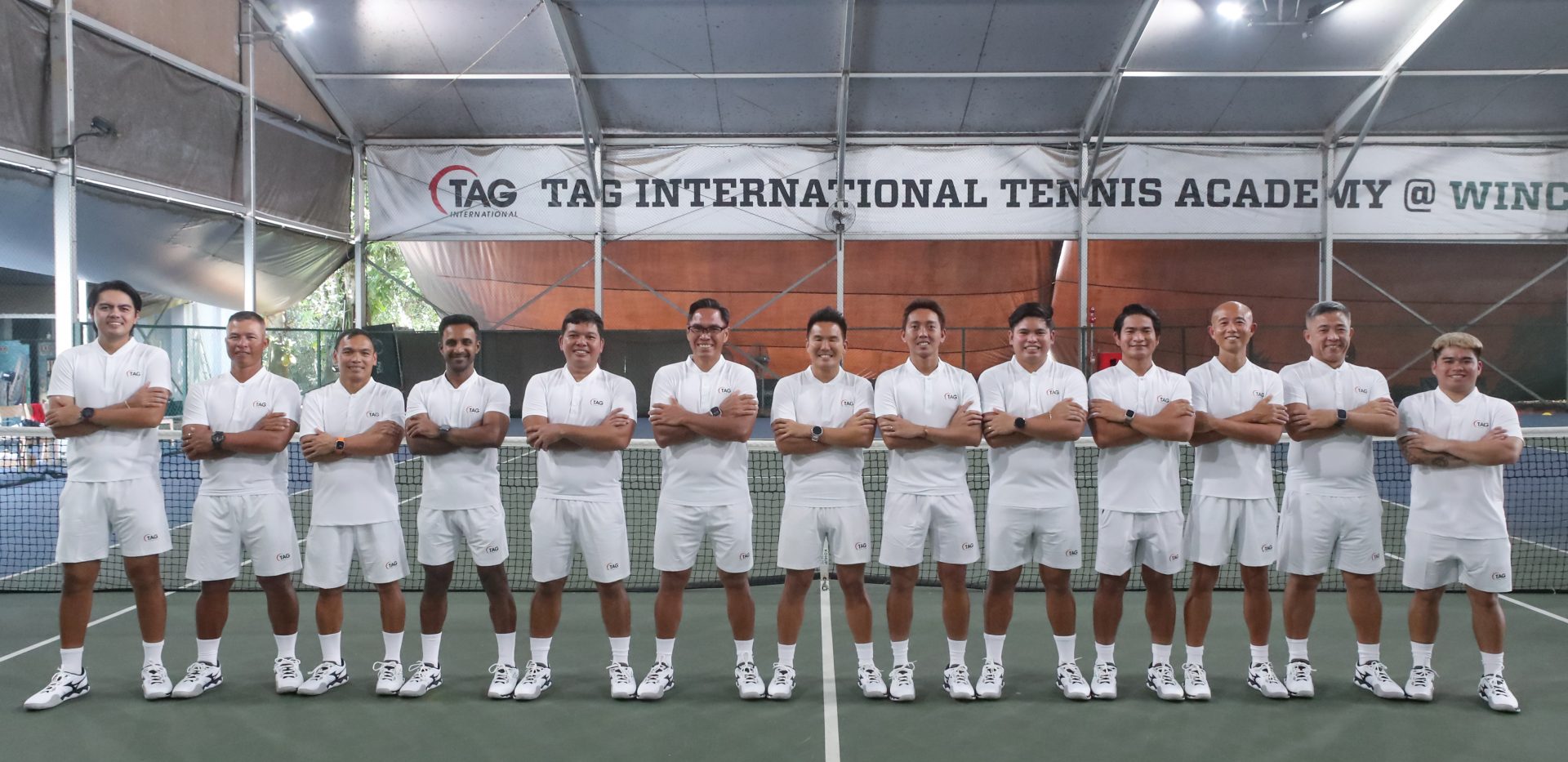
‘Am I too old to start?’ It is one of the most common questions I hear from adults who walk onto our courts for the first time – usually said half-apologetically, as if tennis were a club that had quietly closed its doors to anyone who did not join as a child. After more than two decades coaching players of every age with TAG International Tennis Academy, I can tell you plainly: it is almost never too late to learn tennis as an adult. I have taught complete beginners in their thirties, forties, fifties and beyond who went from never having held a racquet to rallying with real control, playing social matches and genuinely loving the game. Here is an honest guide to what learning tennis as an adult in Singapore actually looks like – what is realistic, what gets in the way, and how to start well.
Reviewed by Coach XT (Tan Xu Teng), founder of TAG International Tennis Academy, who coached Singapore’s Men’s National Team in 2018 and holds PTR Full Professional certification. He reached a career-high ITF Men’s 35+ world ranking of #56 and was Singapore’s #1 ranked men’s doubles player in August 2018 – his full playing record and certifications are published on his own profile at coachxt.sg.
You are not too old – and you are far from alone
The feeling that you have ‘left it too late’ is one of the most common things adult beginners carry onto the court, and it is almost always about confidence rather than capacity. Tennis has no age cut-off for taking it up – our adult beginners range from busy professionals in their late twenties to active retirees, and across Singapore more and more adults are picking up a racquet for the first time, whether for fitness, stress relief or simply to do something social that is not scrolling a phone. Nobody is watching you as closely as you fear, every good coach has started dozens of adults from zero, and the only real mistake is letting the idea of being ‘a beginner at my age’ stop you from ever trying. Once you are on court and rallying, that worry tends to evaporate within the first lesson or two.
What the research actually says about learning as an adult
The science is firmly on your side. Decades of motor-learning research – summarised in reviews such as Claudia Voelcker-Rehage’s study of age-related differences in motor-skill learning – find that adults, including older adults, retain a genuine capacity to acquire new movement skills throughout life. The honest nuance is that age tends to affect the rate rather than the ceiling: an older learner may pick up the most complex coordination a little more gradually, and reach it with a little more repetition, but the improvement is real and it keeps coming with practice. In other words, age is not a barrier to learning tennis; it is just a reason to be patient with the process and consistent with your practice. That matches exactly what I see on court – adults who show up regularly improve, every time, regardless of the number on their birth certificate.
What adults bring that children don’t
It is easy to assume children have all the advantages, but adult learners have real strengths of their own – and good coaching leans on them. Adults understand an instruction the first time and can act on it deliberately, where a child often needs the same correction fed to them a hundred different ways. Adults can feel what their own body is doing and self-correct between shots. They bring focus, patience and a clear reason for being there, so a 45-minute lesson is 45 minutes of genuine work rather than a battle for attention. And because an adult has usually chosen tennis for themselves, the motivation is intrinsic and durable. In my experience a committed adult beginner who practises between lessons will often out-pace a distracted younger player, precisely because they can direct their own learning.
What’s realistic – and how fast you’ll improve
Here is the honest version. Most adult beginners are rallying with some control within a handful of lessons, and playing simple points within a few months of consistent weekly practice. Reaching a comfortable social-match level – where you can hold a rally, serve to start a point and enjoy a friendly game – is a realistic goal for almost anyone who sticks with it. What decides your pace is not your age but how regularly you play: one focused lesson a week plus a hit with a friend will carry you far faster than an occasional burst every few months. For a fuller breakdown of what the early stages look like, our complete guide to tennis lessons for beginners in Singapore walks through the first lesson, equipment and timelines, and the cost of tennis lessons in Singapore sets out what to budget.
The real obstacles – and how we coach around them
The hurdles that actually stop adults are rarely about age. The biggest is the ‘I have no coordination’ myth – hand-eye coordination is itself a trainable skill, and it improves fast once you start feeding it. Time is a genuine one, which is why we keep lessons flexible and efficient. Self-consciousness fades quickest when you learn privately or in a small group of people at your level. And old niggles or a long lay-off are real, but they are managed, not disqualifying – a good coach simply adjusts the load. If you used to play years ago and are dusting off the racquet, the path back is a little different, and our guide to getting back into tennis as an adult is written for you. If you are over 55, our dedicated guide to tennis for seniors covers starting safely after 55 in more detail.
How to start the right way in Singapore
The simplest start is a few lessons with a coach who regularly teaches adults. Private lessons give you the fastest technical progress and a programme built entirely around you, which many self-conscious beginners prefer at first; group or adult tennis lessons are more affordable and more social once you have the basics. We coach island-wide – at your condo, at indoor courts, or wherever is convenient – and our guide to where to play tennis in Singapore helps you pick a venue. If a full tennis court feels like a lot on day one, a gentler racquet sport with a shorter learning curve, such as pickleball at PickleChoo, is a friendly on-ramp and a fine cross-training complement – plenty of our adults happily play both.
Coached by players who have been to the top
One thing that genuinely accelerates an adult beginner is being taught by someone who has played at a high level and can show you how a stroke should feel, not just describe it. A tennis coach in Singapore who has competed seriously brings that first-hand feel to every lesson, and our network is unusually deep in it. Alongside TAG’s own Coach Bo Alburo (a career-high ITF Men’s 35+ world No. 2), we work closely with Sanwa X and former ATP-ranked professional Coach Kento Takeuchi (a career-high ATP World No. 378 and an All-Japan Champion), as well as Sanwa X head coach Coach Wataru Ochi, who has more than 25 years of coaching experience. You do not need to have any ambition beyond a good Saturday hit to benefit from that depth of experience – it simply means the fundamentals you learn as an adult beginner are the right ones, taught well, from the very first lesson.
FAQ
Am I too old to start tennis as an adult?
Almost certainly not. There is no age at which the body stops being able to learn new movement skills, and coaches routinely take on complete beginners in their thirties, forties, fifties and older. Adults tend to improve a little more gradually than children on the most complex skills, but with regular practice they make real, visible progress – and they often enjoy the game more because they chose it for themselves.
How long does it take to learn tennis as an adult?
Most adult beginners are rallying with some control within a handful of lessons, and playing simple points within a few months of consistent weekly practice. How fast you progress depends far more on how regularly you play than on your age. Reaching a comfortable social-match level is a realistic goal for almost anyone who sticks with it.
Are private or group lessons better for an adult beginner?
Both work. Private lessons give you the fastest technical progress and a programme built entirely around you, which many self-conscious adult beginners prefer at the start. Group lessons are more affordable and more social, and let you practise rallying with players at a similar level. Many adults start with a few private lessons to build the basics, then join a group.
Do I need to be fit before I start tennis?
No. You start at your own pace and your fitness improves as you play – that is one of the best things about taking up the game as an adult. A good coach will manage the intensity to match you, especially in Singapore’s heat, and build you up gradually. If you have an existing injury or health condition, mention it to your coach and check with a doctor first.
Related reading
- Adult tennis lessons in Singapore – private and group coaching for every level
- Tennis lessons for beginners in Singapore – the complete starter guide
- Where to play tennis in Singapore – a coach’s guide to your court options
Thinking it might finally be time to pick up a racquet? WhatsApp us at +65 9029 8400 and we will match you with a coach who loves teaching adult beginners – no experience, and no apologies about your age, required.
