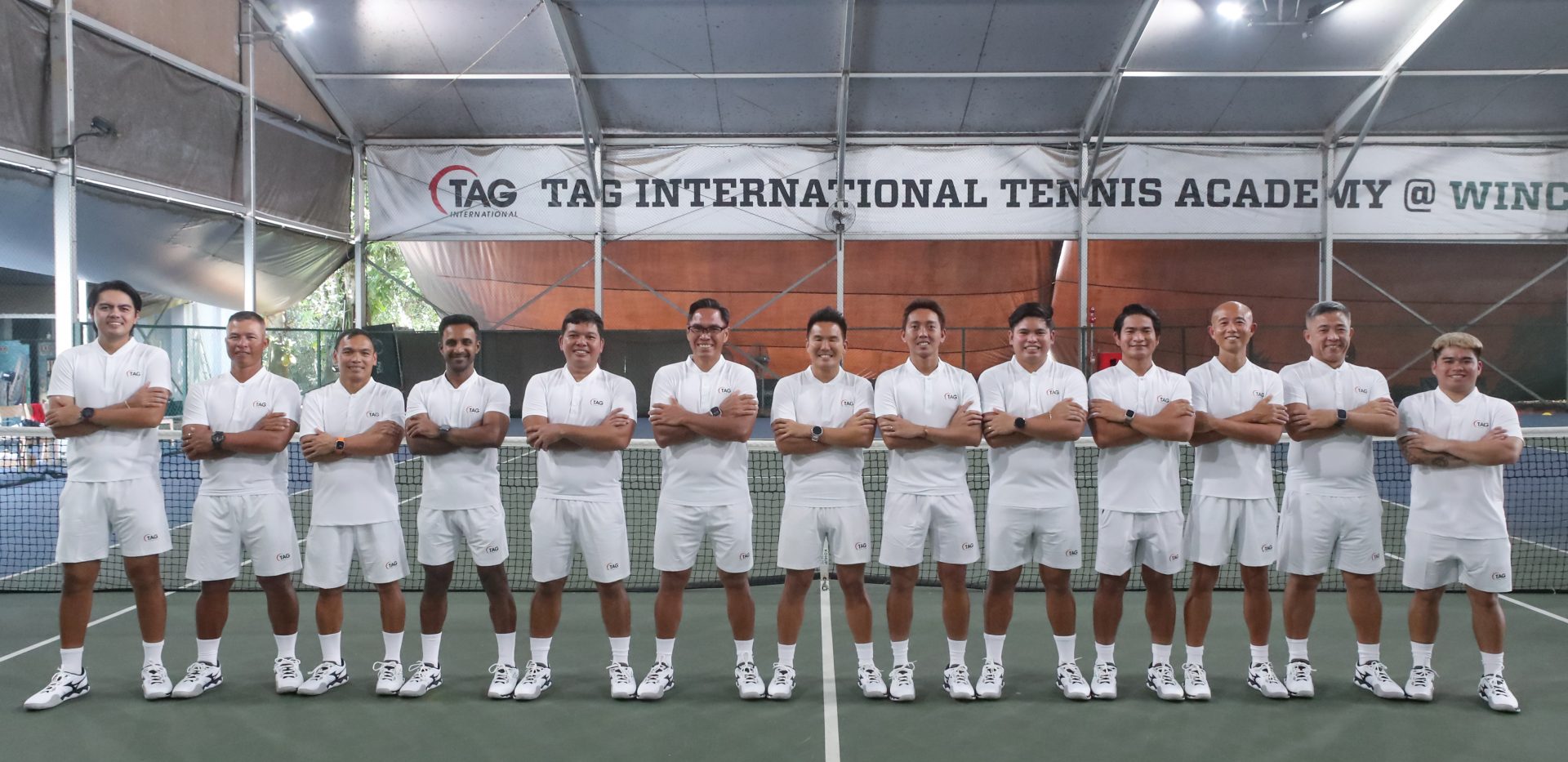
Ask most adult players what they want to improve and they will point at their forehand, their serve, their backhand — almost never their feet. Yet after coaching competitive and recreational players for over fifteen years with TAG International Tennis Academy, I can tell you that the single biggest difference between a frustrating rally and a clean one is usually not the stroke at all. It is whether you arrived at the ball early, balanced and in position to hit it. Tennis is played with your feet; the racquet only finishes the job. Here is an honest coach’s guide to tennis footwork for adult players in Singapore — what actually matters, what the movement really looks like, and a few simple habits you can start building this week.
By Coach Peter Egos, Singapore Open 2019 Men’s Doubles Champion and Head Tennis Coach at the Chinese Swimming Club in Katong, with more than fifteen years of coaching experience and 500+ players developed as a senior member of the TAG International Tennis Academy coaching team — verify his credentials at source on his own profile.
Why footwork is the shot you never knew you were missing
When a shot goes wrong, it is tempting to blame the swing. But in my experience most mistimed balls among adult players trace back a fraction of a second earlier — to the feet. You were late, so you reached; you reached, so you lost your balance; and off-balance, even a textbook swing sprays the ball. Good footwork is simply the art of buying yourself time and arriving in balance, so that hitting the ball becomes the easy part. It is also the most democratic skill in the game: you do not need a junior’s wrist speed or a professional’s power to move better. Movement is trainable at any age, and improving it tends to lift every other part of your game at once.
What the movement really looks like
It helps to know what tennis movement actually demands, because it is not what most people picture. Analyses of match-play movement — summarised by Mark Kovacs in the NSCA’s Strength and Conditioning Journal — have found that more than 70% of a player’s movements are side-to-side rather than forwards or backwards, that players average roughly four changes of direction in a single point (and sometimes far more in a long one), and that the great majority of shots require only a short move, typically under about two and a half metres. In other words, tennis is a sport of many small, sharp, mostly sideways adjustments, not long sprints. That is good news for adult players: you are not training to run marathons, you are training to start, stop, change direction and rebalance quickly over short distances. Those are exactly the habits coaching can build.
The split-step: the one habit that changes everything
If you take only one idea from this article, make it the split-step. Just as your opponent strikes the ball, you give a small hop and land lightly on the balls of both feet, knees soft, weight forward. That tiny unweighting is what lets you push off instantly in whichever direction the ball goes — it removes the inertia of standing flat-footed. Almost every adult I coach improves their court coverage the moment they start split-stepping in rhythm with the opponent’s contact, because they stop reacting late. The common errors are easy to fix: splitting too early (so you have already landed and gone flat before the ball is struck), splitting too big and high (which costs you time coming down), or forgetting to do it at all between shots. Time it to their contact, keep it small and springy, and let it become automatic.
The first step, the recovery, and the ready position
Around the split-step sit three habits that separate smooth movers from scramblers. The first step should be explosive and economical — a short pivot or cross-step that turns your body and sends you toward the ball, rather than a lazy shuffle that leaves you reaching. The recovery step is the one adults most often skip: after you hit, you move back toward the middle of your likely next shot, usually with quick side-shuffle steps, so you are not stranded out wide. And the ready position is where it all resets — feet a little wider than your shoulders, weight forward, racquet up and in front, never caught standing upright and still. None of this requires youth or raw speed. It requires knowing the pattern and repeating it until your feet do it without being asked, which is precisely what a few focused lessons can give you.
Moving well in Singapore’s heat
There is a local wrinkle worth naming: good footwork is also energy management, and in Singapore’s heat energy is precious. Efficient movers waste fewer steps, recover to a sensible position instead of over-chasing, and therefore stay fresher deep into a session. When you are tired, footwork is the first thing to go — the split-step disappears, the recovery step vanishes, and suddenly every ball feels rushed. That is one more reason to groove efficient movement patterns rather than relying on fitness alone. For how to train and play sensibly in the climate itself, our guide to tennis in Singapore’s heat and humidity covers hydration, timing and pacing in detail; think of footwork as the movement side of the same coin.
Three footwork habits adult players can build this week
You do not need special equipment to start. First, shadow the split-step: with no ball, watch a rally (even on a screen) and hop lightly on every contact until the rhythm feels natural — then carry it onto court. Second, add a recovery step to every shot in your next hit: make a rule that after you strike the ball you take two side-shuffle steps back toward the middle before you stop. It will feel like extra work for one session and automatic by the third. Third, play “small-court” points inside the service boxes with a friend: the short court forces constant small adjustments, quick direction changes and soft hands, which is footwork training disguised as a game. A coach can compress months of this into a few sessions by watching your feet rather than your racquet and feeding you to the exact patterns you need — something that is genuinely hard to self-diagnose.
Learn to move from players who did it at the top
Footwork is one of those skills that is far easier to absorb from someone who has moved under real pressure than to read about. A tennis coach in Singapore who has competed seriously can show you how balanced movement should feel, not just describe it — and our network runs deep in exactly that experience. TAG’s own Coach Bo Alburo reached a career-high ITF Men’s 35+ world No. 2 in singles, where movement and court coverage win matches. Through Sanwa X we work alongside former ATP-ranked professional Coach Kento Takeuchi (a career-high ATP World No. 378 and an All-Japan Champion) and Sanwa X head coach Coach Wataru Ochi, who brings more than 25 years of coaching experience. One more thing worth knowing: the surface you play on changes how you move, from footing to recovery — our guide to tennis court surfaces in Singapore explains why. And if you want to sharpen multidirectional movement in a lower-impact way, the quick starts and stops of pickleball at PickleChoo make a surprisingly good cross-training complement.
FAQ
What is the most important footwork skill in tennis?
For most players it is the split-step — the small hop and light landing timed to the moment your opponent strikes the ball. It unweights your body so you can push off instantly in any direction, which is why it is the first thing I teach when a player wants to move better. Get the split-step consistent and in rhythm, and your court coverage improves immediately, before you change anything about your strokes.
Can adults really improve their footwork, or is it only for juniors?
Adults absolutely can. Tennis movement is built mostly from short, sharp, sideways adjustments rather than raw sprinting speed, and those patterns — the split-step, first step, recovery step and ready position — are learnable at any age with repetition. Adult players often improve quickly because they can understand the pattern, feel what their feet are doing and deliberately repeat it, where a child needs the same idea fed to them many different ways.
How can I practise tennis footwork on my own?
Start with no racquet at all: shadow the split-step by hopping lightly on every imagined contact until the rhythm is automatic. Then, in your next hit with a friend, make a rule to take two side-shuffle recovery steps toward the middle after every shot, and play short “small-court” points inside the service boxes to force quick, small adjustments. These simple drills build the habits without any special equipment; a coach can then refine them by watching your feet directly.
Does footwork matter more in Singapore’s heat?
In a sense, yes — efficient footwork is also energy management, and in Singapore’s heat that matters more. Players who move economically waste fewer steps and stay fresher through a session, while tired players lose their split-step and recovery first and start rushing every ball. Grooving efficient movement patterns, alongside sensible hydration and pacing, helps you play better for longer in the climate.
Related reading
- Is it too late to learn tennis as an adult? A Singapore coach’s guide for beginners
- Getting back into tennis as an adult in Singapore — a coach’s guide for returning players
- Tennis court surfaces in Singapore — how each one changes your game
Want a coach to watch your feet, not just your forehand? WhatsApp us at +65 9029 8400 and we will match you with a coach who can turn your movement into the quiet strength of your game — at your condo, at an indoor court, or wherever you play across Singapore.
